Many owners in Muscat ask themselves: why pay a property manager when I can deal with the tenant myself? It is a fair question, but it is framed incompletely. Managing a property yourself is not free; you pay for it in ways that never appear on an invoice: an empty month here, late rent there, a small fault left until it grew, and hours of your time that nobody counts.
In this article we put the comparison on paper: what you actually take on when you manage your own property, how to work out whether a manager would save you money, the signs that it is time, and when staying your own manager is enough.
What do you actually take on when you self-manage?
Owners tend to think self-management means collecting rent each month. The real work is spread across the whole year, and it usually arrives at times you did not choose:
- When a unit falls empty: pricing, photos, listing, answering enquiries and viewings.
- Before signing: checking the tenant, drafting the contract, then registering it with the municipality, which is the duty of the landlord or their agent.
- Every month: tracking payments, chasing late payers and reconciling what reached your account.
- All year round: maintenance requests, finding a technician, and making sure the work was done at a fair price.
- Before the lease ends: renewal or move-out, inspecting the unit and settling the deposit.
The costs that don’t show up in self-management
Empty months
This is often the biggest cost and the most hidden. Every month a unit stands without a tenant is a full month’s rent that never comes back. A busy owner is usually slow to list, reply and arrange viewings, so the vacancy stretches week after week without them noticing.
Late rent
Late payment starts small. With an owner who doesn’t follow up on a fixed date, the tenant learns that the due date is flexible, and one month piles on another. Regular, written follow-up from day one is far easier than recovering several months of arrears.
Deferred maintenance
A small leak not fixed today can become damp in a wall or a damaged ceiling tomorrow. An air conditioner not checked before summer can fail on the hottest days, when technicians are in demand. Preventive maintenance on schedule is usually cheaper than an emergency repair.
Your time
Count the hours you spent on your property last year: calls, viewings, trips and chasing technicians. Then ask: what would those hours be worth spent on your work or your family? That figure is a real part of the cost of self-management, even if you never pay it in cash.

A simple calculation: would a manager save you money?
The rule is simple: a property manager pays for itself if what it saves you is greater than its fee. Those savings come from four places: fewer empty months, lower arrears, fewer emergency repairs, and time back in your hands.
An illustrative example with hypothetical figures, not market prices or any company’s fees: an owner has four flats, each let at OMR 250 a month, which is OMR 12,000 a year if all stay let. If two of them stand empty for two months a year because listing and viewings were slow, that is four months of rent, OMR 1,000 lost without ever appearing on a bill.
Now ask: how many of those four months would a professional have saved by listing and arranging viewings sooner? A managed unit can also stand empty between tenants, so what counts is the difference, not the whole figure. Set that difference, plus any arrears lost and the value of your time, against the fee an office quotes you. If the total is greater than the fee, management saves you money as well as time. If it is smaller, managing it yourself may be enough, or a smaller service may suit you.
Don’t compare a management fee with zero. Compare it with what your property costs you today while you manage it: empty months, arrears, emergency repairs and your time.
Signs you need a property manager
- You live outside Muscat or outside Oman, and can’t attend a viewing or follow up a fault yourself.
- You own more than one unit, or a whole building, and keeping track has become a daily job.
- Late rent has become a pattern, or a tenant has fallen more than a month behind.
- Your units stay empty between tenants for longer than they should.
- You don’t know exactly how much you spent on maintenance last year.
- You only notice a lease is ending when the tenant tells you they’re leaving.
If more than one of these applies, it’s worth running the calculation above with your own numbers.
When is managing it yourself enough?
Full management isn’t necessary for every owner. Doing it yourself may be enough if you have one or two units close to where you live, a tenant who has paid reliably for years, a trusted technician you can call, and time to give the property without taking it from your work. The condition is that you run it like a business: a clear, registered contract, fixed follow-up dates, and a written record of every payment and every expense.
The middle option: letting only
Between doing everything yourself and handing the property over entirely, there is a third option that suits many owners: a real estate office handles the letting only. It prices and lists the unit, arranges viewings, checks applicants and recommends the best fit for your decision, then prepares the contract and handles its registration with the municipality, and you take over collection and maintenance from there. It suits owners who want the hardest stage, filling an empty unit, in a professional’s hands, and can manage what follows themselves.
A property nobody manages ends up managing itself, usually at your expense.
If you decide to hand your property over, the questions to ask before signing, from scope and fees to transfer dates and monthly statements, are in the owner’s guide linked above.
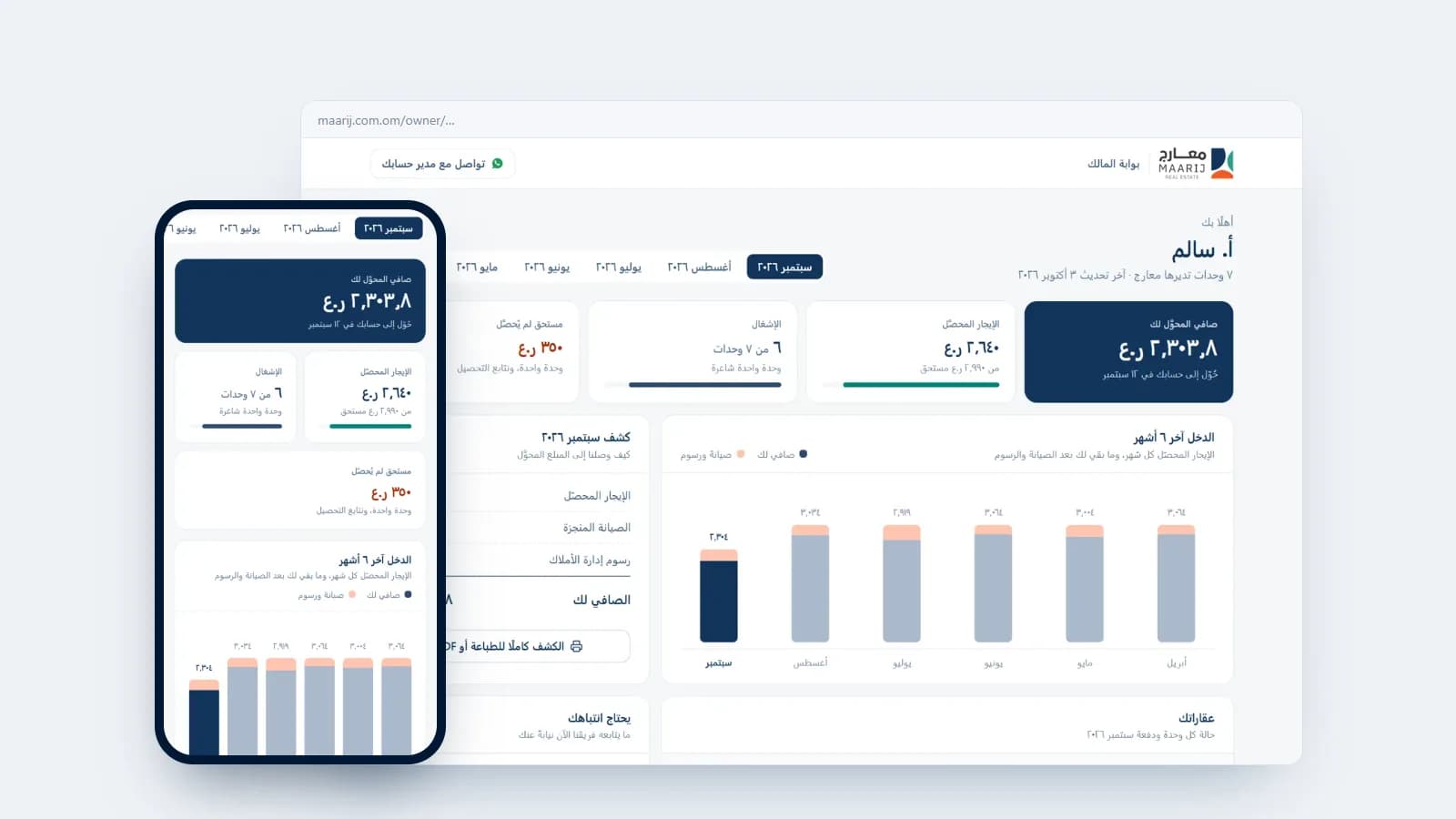
At Maarij Real Estate we offer both options: letting only, or full property management from marketing and contracts to collection and maintenance. Every owner we manage gets a private link to see their rents, maintenance and monthly statements at any time, and if you would like to see an example before deciding, it is available (in Arabic) on the service page.
Learn about our property management serviceThis content is general guidance, not legal or financial advice; always confirm current requirements and fees with the competent authorities.
Frequently asked questions
Is property management worth it if I only own one flat?
You may not need full management for one flat near you with a reliable tenant. It is worth considering if you live far away, or if the flat keeps standing empty or the rent keeps arriving late. Letting only may be enough.
I live outside Oman. Do I need a property manager?
Usually yes, because viewings, maintenance requests and chasing arrears all need someone on site. Make sure the company sends you a written monthly statement and transfers on a fixed date.
Who registers the tenancy contract with the municipality if I use a property manager?
Registration is the duty of the landlord or their agent. If the management company handles it on your behalf, put that in your agreement and ask for a copy of the registered contract.
What is the difference between letting only and full property management?
With letting only, the office markets the unit, recommends a tenant and prepares the contract, then hands the rest back to you. With full management it also collects rent, handles maintenance and renewals, and sends you regular statements.
How do I know whether a management fee is reasonable?
Compare it with what your property costs you today: empty months, arrears, emergency repairs and your time. Ask for the fee in writing, and for it to appear as a clear line on every statement.
Need help with a property decision?
Talk to the Maarij team now — we reply on WhatsApp within minutes during working hours.